
A List of 7 Specialized Accessibility and Assisted-Care Products
Posted by Handy Washroom on Aug 11th 2026
Specialized Accessibility and Assisted-care Equipment
The list below introduces seven types of accessible washroom equipment available for commercial, institutional and assisted-care projects. You can also print this PDF explaining Specialized Accessibility and Assisted-care Equipment for future reference.
Equipment for Assisted Changing and Personal Care
Changing equipment must provide a safe surface for the user while allowing caregivers to work at an appropriate height. The right configuration depends largely on:
- whether the table will be used for showering
- moved between care areas
- permanently installed in a public washroom
The following is a list of each type of changing equipment and the applications it is best suited for.
1. Powered Height-Adjustable Shower and Change Tables
Powered shower and change tables are designed for facilities where adults or children with reduced mobility require assistance with changing, dressing and personal care.
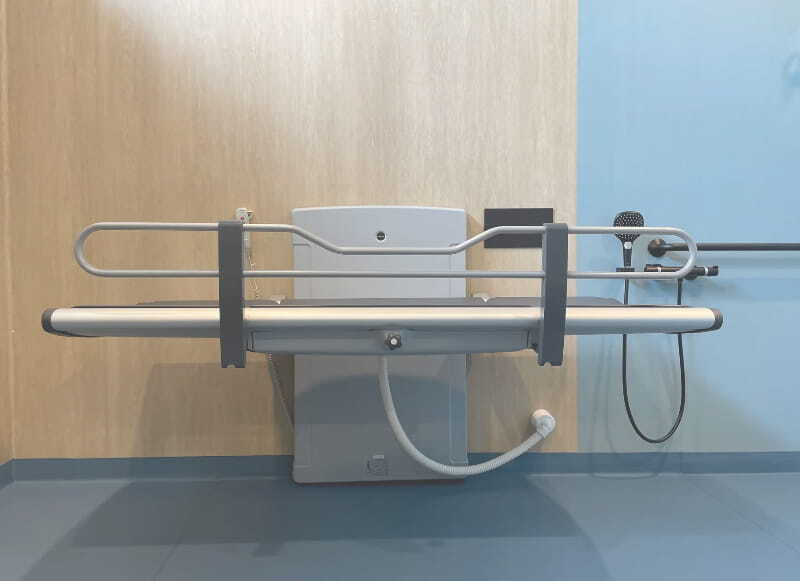 The height can be adjusted to support transfers and place the user at a practical working level for the caregiver. There are also models designed for wet environments that can be used during assisted showering.
The Pressalit SCT 3000 powered adult change table is one example.
It provides electric height adjustment, a full-length changing surface and a safety rail to help keep the user secure.
Different table lengths are available to accommodate individual users and room dimensions and are suitable for schools, hospitals, care institutions and private residences where regular assisted care is provided.
Here's more information explaining why Pressalit has become a leading providor of accessible washroom equipment.
2. Mobile Electric Change Tables
Where care is provided in several rooms, a mobile change table is an alternative to installing permanent equipment.
The table can be repositioned as needed and provid powered height adjustment for transfers to optimize caregiver access.
The Can-Dan mobile electric height-adjustable change table adjusts from approximately 20 to 36 inches and supports up to 450 pounds (204kg). It features a removable mattress, body safety belts and a secure changing surface, with optional side rails for further support.
The Can-Dan is particularly useful in treatment centres, schools and facilities with shared care spaces.
3. Wall-Mounted Adult Changing Stations
Wall-mounted adult changing stations provide a full-length changing surface for users who cannot be accommodated by standard baby-changing equipment.
Their fold-down design makes them suitable for universal and accessible public washrooms because they save valuable floor and transfer space, and can be returned to the wall when it is not in use.
The Koala Kare KB2600 adult changing station is an example that offers electric height adjustment and supports up to 440 pounds (200kg). It features an integrated safety guard, a water-resistant changing surface and battery backup for operation during a power interruption.
These features make the KB2600 suitable for public washrooms in institutional environments that require dependable adult changing spaces.
Equipment for Supported Bathing and Toilet Use
Accessible bathing and toilet facilities need to account for users with limited balance and strength. Proper seating and support equipment make transfers safer, provide more stability and allow users to maintain a comfortable position.
4. Bariatric Folding Shower Seats
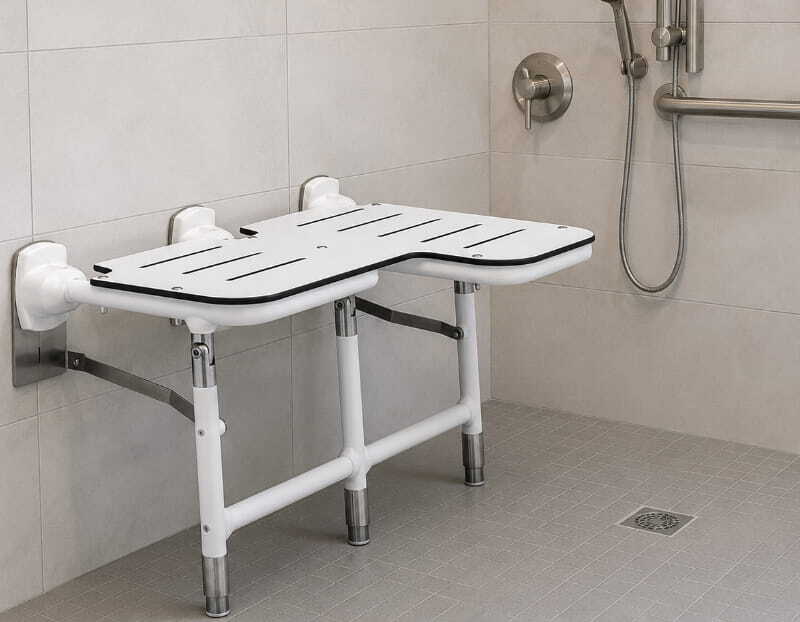 Bariatric shower seats provide a wider and stronger seating surface for users who need to site while showering.
The additional weight capacity makes them suitable for facilities that accommodate a broad range of body sizes and support requirements.
The Bobrick B-918116 bariatric folding shower seat incorporates swing-down legs and supports up to 1,102 pounds (499kg) when properly installed.
It is built with a water-resistant surface with drainage slots, while the folding design preserves shower space when it is not in use to.
5. Flip-Up Toilet Safety Rails
A flip-up safety rail provides a stable handhold during wheelchair transfers and while a user is sitting down or rising from the toilet.
Unlike a fixed rail, it can be raised when clear side access is required and lowered into position when support is needed.
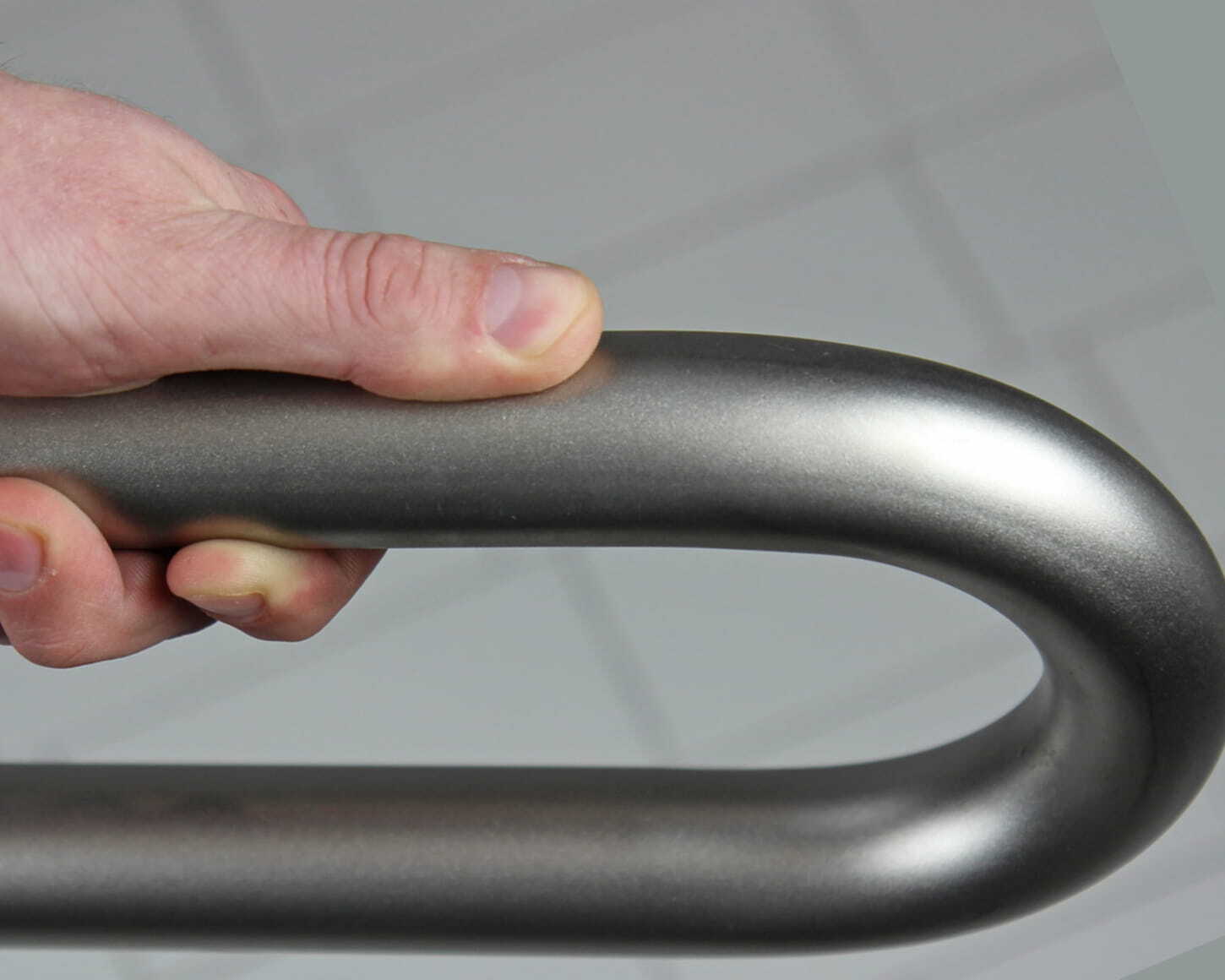 The Frost 1055 flip-up safety rail can be locked in either its horizontal support position or its upright position against the wall. This helps keep the rail stable during use and out of the transfer area afterward.
Because the effectiveness of any safety rail depends on its installation, suitable wall reinforcement and secure anchoring must be confirmed before the unit is put into service.
6. Padded Toilet Backrests
Tankless toilets do not provide the rear support that some users require to maintain a safe and comfortable seated position.
A dedicated toilet backrest fills this gap without interfering with the accessible layout surrounding the fixture.
The Bobrick B-5892 padded toilet backrest combines a polyurethane support pad with a stainless-steel grab-bar rail. It is intended for barrier-free and universal washrooms where the toilet does not have a tank or seat cover that can serve as back support.
When properly specified and installed, the unit can also help the washroom satisfy applicable Ontario Building Code requirements.
Fixtures That Support Independent Washroom Use
Some accessibility products allow people to use a washroom more independently rather than assisting with a physical transfer. These fixtures address practical details that conventional washroom designs often overlook.
7. Fixed Tilt Mirrors
A standard flat mirror may be mounted too high to provide a useful reflection for someone seated in a wheelchair.
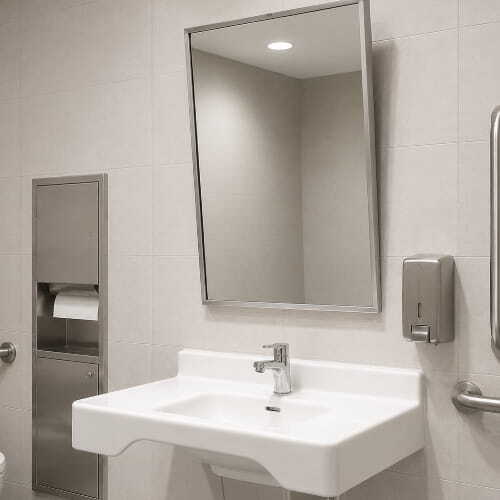 A fixed tilt mirror angles the reflective surface downward, improving visibility without requiring the user to stand or reposition excessively.
The Bobrick B-293 fixed tilt mirror is designed for barrier-free and universal washroom applications. It extends farther from the wall at the top than at the bottom, creating a permanent viewing angle for seated users.
The mirror is available in several sizes and has a stainless-steel frame suited to commercial and institutional washrooms.
How to Select the Right Accessibility Equipment
Before selecting equipment, consider the following project requirements:
Determine Intended Setting
Determine whether the equipment will be installed in a commercial, institutional or residential setting. Each product has different capacity, durability and maintenance requirements and should be matched to the space where it will be used.
Confirm Available Space
Confirm that the room provides enough space for the use of the equipment, user, caregiver, mobility device and transfer equipment. Make sure to measure folding products in both their open and stored positions to ensure they will not obstruct doors, fixtures nor accessible clearances.
Determine Installation Method
Determine whether the equipment should be wall-mounted, floor-supported, mobile or folding. The proper installation method will depend on the available space, how frequently the equipment is used and whether it needs to be moved between care areas.
Review User Requirements
Review the equipment's dimensions, weight capacity, adjustment range and safety features in relation to its intended use. Consider whether the equipment will be used for adults or children, wet or dry care and assisted or independent use.
Confirm Caregiver Needs
After installation, confirm that the caregiver can comfortably access the user, operate the controls and safely complete transfers. Select equipment that gives the caregiver clear access to the user and controls throughout the transfer and changing process.
Confirm Building-Code Requirements
Confirm that the selected equipment and its placement satisfy the accessibility and building-code requirements that apply to the project. The surrounding clearances, installation height and other washroom fixtures must also be considered.
Verify Structural Support
Verify that the supporting structure can support the equipment and its intended load. You can review the manufacturer’s mounting requirements to determine whether wall blocking, reinforcement or a support carrier is required.
Identify Electrical, Water and Drainage Requirements
Identify the electrical, plumbing and drainage requirements before construction begins. Confirm the required connection locations and installation specifications so the equipment can safely operate as intended.